Yellow Flowers in the Botanic Gardens


In the middle of September, I biked to the Botanic Gardens with my macro-filters 
to document the expanse of yellow flowers. I positioned the lens to frame the flowers 
in front of the field ending at the sky so as to create a pseudo-landscape. It was windy 
and nearly impossible to get a focused shot.


Primary colors make for good nature photographs. It aesthetically simplifies a natural
 subject and scene to render the emotion and tone more base and in that sense more 
amusing or appealing. Oodles of sunlight helps enhance primary colors. These yellow
 flower photos are nice.

Glencoe
Taken in September 2012

Undergrowth in the Snow on the Skokie Lagoons


While hiking along the frozen mud slopes of the Lagoons and scanning the barren
 and fog cloaked water for interesting landscape compositions, I was struck by 
the Pollock-like nature of the still green grass splattered over the fresh layer of white 
snow. I raised my lens vertically above the snow and framed-out any colors that did 
not fit the canvas well. I paid more attention to the undergrowth, and later, in a dense
 field of dead grass and broken trees, I crouched to ground-level and attempted at 
warping perspective and thus the viewer's perception of the size of the grass.


The artistic potential of undergrowth cannot be overstated. Especially autumn leaves,
 which themselves create both a portrait and a landscape because of their tones and 
complexity. Ansel Adams has a famous photograph of a leaf that illustrates this point 
well. He even developed it onto a door, somehow. There's something both intricate and
 minimal about the things we step on.

Winnetka
Taken in December 2012

House Sparrow in the Snow on the Skokie Lagoons


While meandering along the shore of the Skokie Lagoons during winter break trying
 to spot any sort of bird, I startled a small host of about seven house sparrows. The 
sparrows flew out from the snow into the branches to watch me, and since they clearly 
didn't want to abandon the area that they were in they sat close enough for me to take
 a few clear pictures. 


It's interesting how something as common as a house sparrow and snowy branches
 can compose a unique design when combined. That's the sort of thing that separates 
wildlife magazine photographers from photographers like Art Wolfe and Michael Nichols;
 where the scene is as well composed as the subject and action-wise both are engaged with
 one another.

Winnetka
Taken in December 2012

Autumn in Harms Woods 2


At the start of autumn I biked to the Chicago River in Harms Woods with my mini 
tripod with a hope that I could create as aesthetically appealing of a photograph of 
the colors and the trees as I had done a year beforehand with my "Stream in Harms 
Woods" shot. It was near dusk so the lighting was poor but the mini tripod allowed for a
 long exposure which augmented the pale glow of the sky. I trekked through the mud 
up to some wetland plants on the shore across from a cliff with the forest elevated on the 
other bank. I spent a few minutes finding a sturdy spot in the mud to stand the tripod and 
took a second and a half exposure.


I cannot believe how long it took me to upload this photo to my blog. I'm proud of how it 
captures the damp, boggy feel of the Chicago River, and also the bright color of the leaves
 in the trees. It's a nice experience photographing in the mud; it sort of artistically 
unifies the photographer with the landscape as to make him understand it more.

Skokie
Taken in September 2012

Ice next to the Skokie Lagoons


One evening during winter break I biked through the cold to the Skokie Lagoons 
and found a nice icy patch on the muddy shore midst where the reeds usually were 
and positioned my camera with its macro filters on the ice. I had gone to the Lagoons 
with the intention of getting a good shot of ice, and the frozen shoreline provided
 that as well as a landscape view tinted by the city's tungsten lights on the horizon, 
which with a long exposure permeated all translucent surfaces.


In the Modern Art course I took over the summer I wrote an essay looking at a painting
 by Marsden Hartley based on an essay by Clement Greenberg, an art critic, where
 he argues that modernism is art coming to terms with its own medium. Based on 
that definition of modernism, Alfred Stieglitz was sort of the first modern photographer
 in that he focused more on what was included in the frame than the quality of the
 subject itself. Personally, I like that definition of photography as being unique in 
that the person wielding the camera can choose what and how the lens captures.

Winnetka
Taken in December 2012

Goldeneyes in the Snow


I went to the Skokie Lagoons several times during winter break to photograph 
waterfowl, and each attempt at photographing goldeneyes--one of the few interesting 
winter birds--proved more unsuccessful than the next. Every time, as I meandered 
closer to the water, the flock would notice me and, alarmed, would rocket out of the 
Lagoon. After one such instance, I hid behind a tree and waited for several minutes 
until four goldeneyes circled back. It was snowing, and as the waterfowl drifted along
 the sheet of ice I captured a few shots of the picturesque scene.


Goldeneyes are neat birds. They look more uniquely designed than any other animal
 I've seen at the Lagoons and fit nicely into the sleepy and snowy winter landscape.
 They are very frustrating to photograph, though; which is an issue. Telephoto lenses
 that are above 300mm are pretty expensive and useless beyond bird photography, so
 there really isn't any lucrative method of photographing birds beyond sneaking up on them.

Taken in December 2012
Glencoe

Wintry Field in Middlefork Savanna Preserve


Because of global warming, the lack of snow has left the wintry prairie 
landscape barren and skeletal. While walking around the Lake Forest half of the 
Middlefork Savanna Preserve on New Years Day, I took a few photographs with
 my 50mm f/1.8 that emphasize the repetitive, wood-colored deadness of the leafless
 trees and dried grass.


After about five minutes of hiking along the path the freezing weather became 
unbearable and I drove home. It's sort of frustrating that forgetting a minor thing 
like a hat disrupted going so out-of-the-way to a place like Middlefork, but I guess 
dressing for adverse conditions is a necessity for nature photography. It never 
really occurred to me until now how the more prepared a nature photographer is 
the more opportunities there are for good shots.

Taken in January 2013
Lake Forest

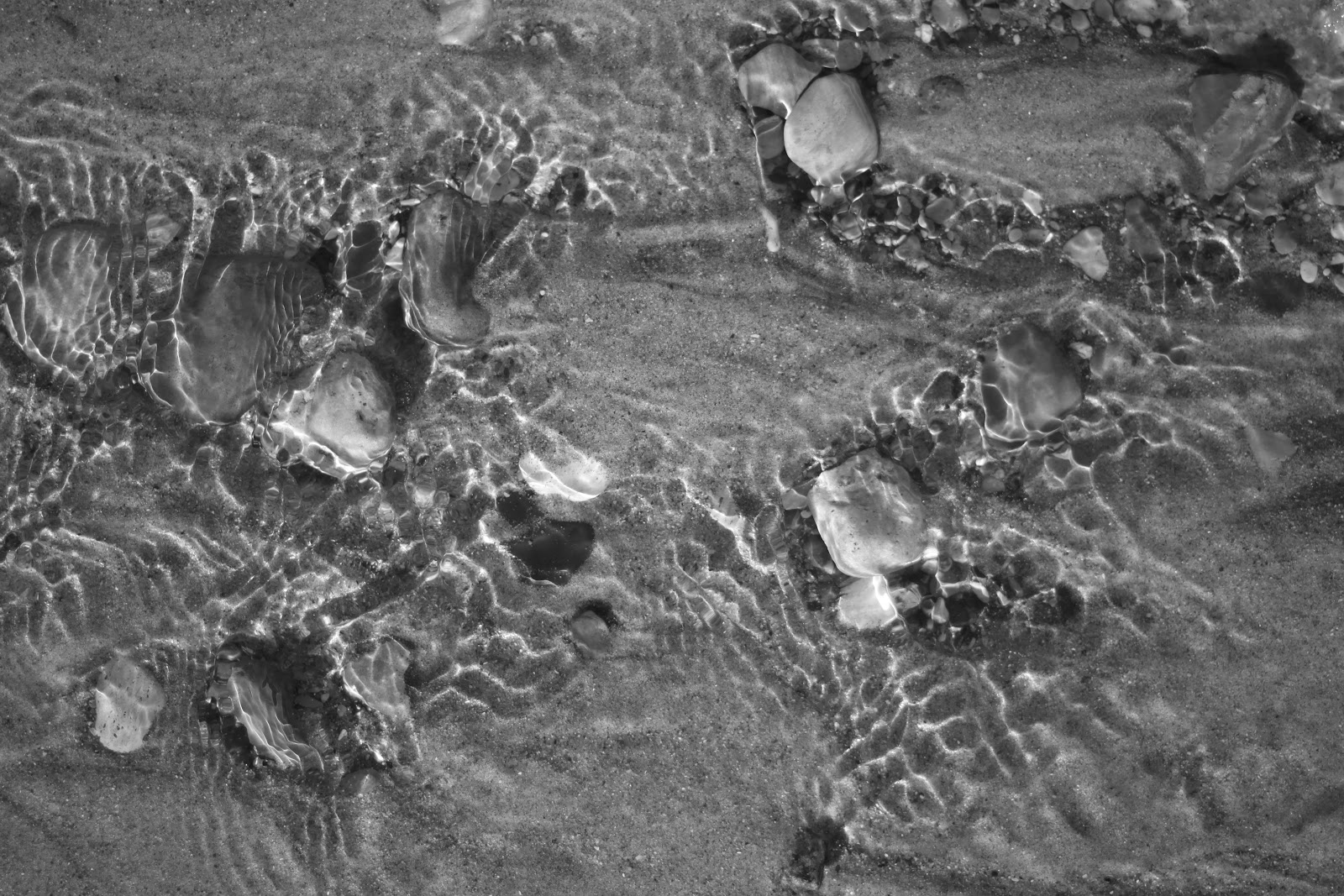
Light flickering in a Stream near Lake Michigan


There's an excuse for a Winnetka public beach on Lake Michigan with a large pipe 
that pours water into a stream which had eroded a mini-canyon through the sand. 
Because of the snow and the freezing temperature, most of the sand was frozen 
and sheets of ice covered the banks of the stream with icicles hanging over. The glint
 of the snow at noon shot sunlight into the stream, and the sunlight splattered and 
flickered across the pebbles. I carved a shallow crenel at the top of one of the walls
 of the bank and leaned my camera downwards to capture a long exposure of sunlight 
dancing through the water.


Reflections in water is the closest natural thing a photographer has to paint, in that 
if the subject is framed and exposed accordingly the result can look very expressionistic. 
Still, I would not recommend photographing a beach in the winter at noon since the 
sand is like cold concrete and the sunlight's blinding gleam on the snow can be a visual 
disadvantage.

Taken in January 2013
Winnetka

Vine sticking out of the Snow in Crow Island Woods


Throughout winter break, since I woke up late in the day, the early sunset
 forced me to venture on photography expeditions for a shorter period of time than
 I would have liked early in the afternoon. While meandering around the Crow Island
 Woods at dusk looking for interesting small plants interacting with snow to photograph
 with my macro-lens filter, I spotted a gnarled vine raised several inches from the snowy
 ground cover. From an aerial view, its muddy color stood out against the alabaster
 background and produced a minimalist and natural arabesque similar to a third 
style Roman wall painting (I'm taking a History of Art class).


Snowy nature is perfect for macro-photography. The color and texture of the snow
 alters small details in nature so singling in on plants can capture a microscopic artistic
 transformation as the plant conflicts with the precipitation.

Taken in December 2012
Winnetka

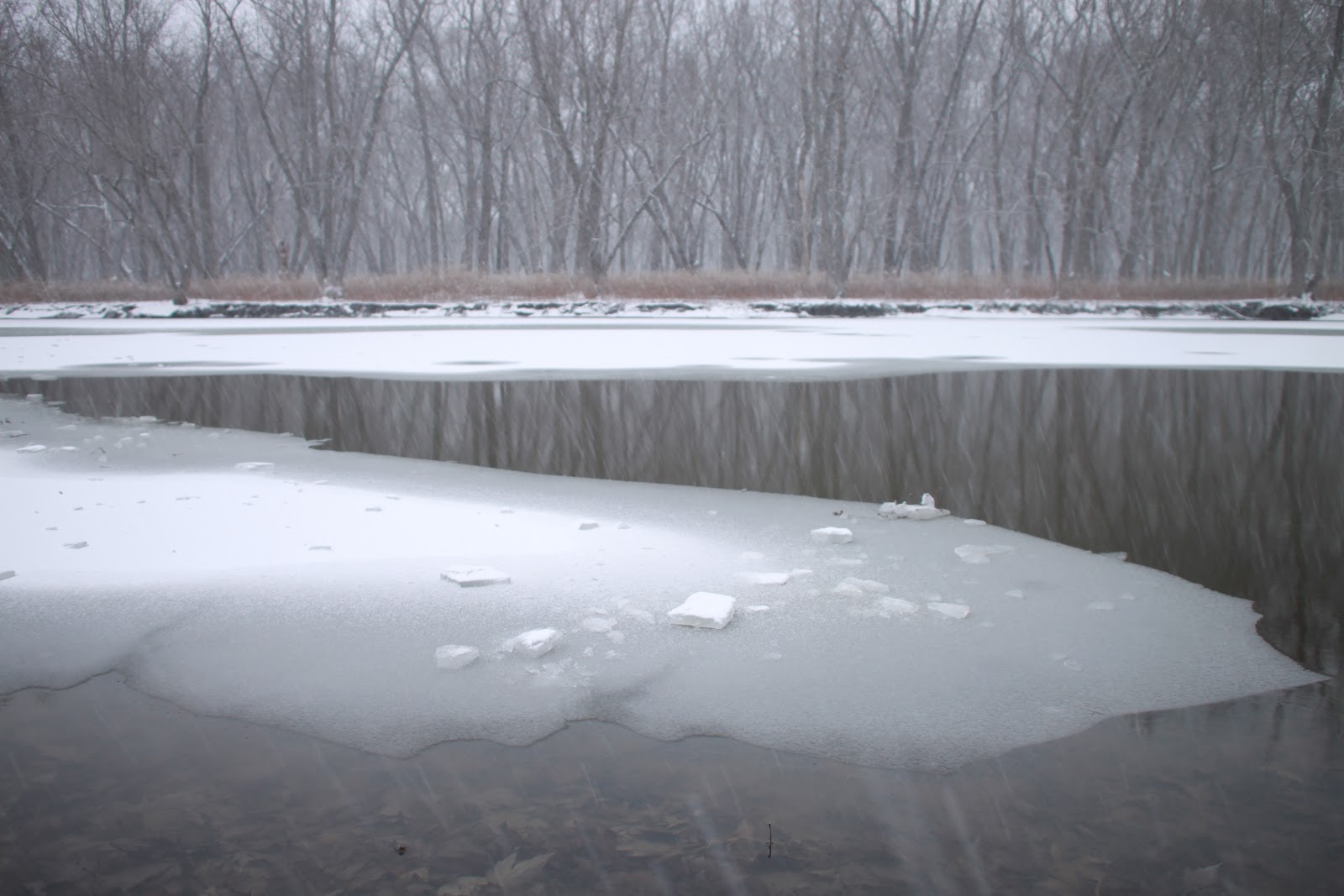
Ice on the Skokie Lagoons during a Snowstorm


In the midst of December, I trekked along the muddy banks of the Skokie Lagoon 
near sunset and dusk when gradually clots of falling snow fogged the forest and 
piled onto sheets of ice over the water. It was cold and icy so I had walked to 
the Willow Road Dam and maintained a reasonable distance from that road so
 that the journey home wouldn't be too arduous. As I ventured away from the Dam,
 the sheets of ice produced interesting patterns and the dense forest seemed more 
and more expansive.


Landscapes without a subject rely on vertical gradient and design. When I saw 
the circles in the snow I knew that I was too low to solely fame the photograph on 
the design on the ice and would need incorporate the trees and fog into the composition. 
The branches that hung over me-- always intruding into river compositions-- 
add to the surreal and almost finite scene, creating a ceiling from the viewer's 
perspective. At the same time, the dots leading the viewer's eye towards the dense, 
fog-filled forest is somewhat eerie.

Taken in December 2012
Winnetka

Bobcat at Elawa Farm in Lake Forest


I was too lazy to bike in the freezing weather yesterday, so I just drove to several 
of the places that I would've normally biked to. Since I had time, I drove to 
Middlefork Savannah Forest Preserve in Lake Bluff and spent a half hour 
figuring out how to access the forest preserve with a car. The car entrance led
 to Elawa Farm, an extremely quaint zoo of Midwestern wildlife, similar to 
the Grove and the River Trail Nature Center except more oriented into
 the surrounding landscape.


Nature centers usually have cages with large birds in them, and Elawa Farm 
had a hawk and an owl and a pond for turtles and frogs (which was frozen over). 
What was unique was the bobcat. I was not aware that bobcats lived in Illinois, 
so like the snapping turtle at the Grove it was a nice reminder of how mysterious and 
terrifying Illinois' forest preserves are. It's also interesting seeing Illinois wildlife in 
a cage because it makes something familiar seem exotic. The bobcat, on the other 
hand, didn't really share my sentiments.

Taken in January 2013
Lake Forest

Ice on Maple Beach


At the start of winter break I realized that I hadn't posted anything during December 
(due mostly to an obscene quantity of homework as well as my loss of interest in 
writing about nature photography since I did not have time to do it anyway), so 
decided to wait out the rest of the month and spend winter break accumulating more 
material. For winter, the biome of the North Shore was set with snow, ice, cold, and
 holiday decor--providing an interesting new scene to explore. Yesterday I travelled
 around to a few places that would have unique wintry landscapes, and stopped by
 Maple Beach in Winnetka to photograph the small ridge of ice which had formed atop
 the sand on the shore. 


The icy water flung a mixture of snow and sand onto the protruding cliff and in the
 top photograph broke off blocks of ice as it burst up the ridge's slope. I went to 
the beach with no intention of capturing that shot but was drawn to it after a trial and 
error process where I took progressively less and less wide angle shots and narrowed 
onto the most intriguing or eye-catching component of the landscape. Even then,
 I crouched in the icy sand and stared through the camera's viewfinder at the spot where 
water seemed to be crashing most for at least ten minutes per crag of ice, tarrying 
until the water splashed to a noticeable height. With the top photograph, I was lucky 
enough to capture the wave actually removing and throwing two pieces of the ice.

Winnetka
Taken in January 2013

Tall Grass in Crow Island Woods 2


While taking pictures at Crow Island Woods during dusk the other day, I placed my 
camera and small tripod a few feet off the trail amid the tall grass and angled the shot 
so that there would be minimal view of the ground. It was cold and although I had to 
bend very low to the ground to compose the shot the sharp undergrowth prohibited me 
from sitting down. It also took me about fifteen attempts to get the framing right.


The warped and atmospheric perspective of the grass shooting upwards is very surreal.
 Because of the jagged and schematic shapes of all the crumpled leaves, it looks as 
though there's a lot of movement. The towering nature of the grass and the perceived
 movement sort of conjure an association with buildings in a city. 

Winnetka
Taken in November 2012

Tall Grass in Crow Island Woods


I checked out a book by Ansel Adams from the library about how he conceived 
40 of his photographs, and for one of his stark landscapes Adams mentioned 
using a red filter to increase contrast. I piled two fluorescent filters and an orange 
graduated filter onto my 18-55mm and twisted a mini tripod onto the bottom of my 
camera and trekked to Crow Island Woods at dusk. I set the camera on the wood-chip
 path and took several low-angle, long exposures of shrubs and foliage. 


Over Thanksgiving break I briefly became obsessed with old photographs and 
spent days venturing across the internet unearthing daguerreotypists (especially 
Roger Fenton and Gustave Le Gray) who artistically documented 19th century events.
 Eventually I organized the best of my findings, from pre-Civil War presidents to 
painted tipis into a blog that I've now abandoned: http://historicalphotographs.tumblr.com
(there are two pages of posts). Either there's something mesmerizing about the quality of 
daguerreotypes themselves or the artistic integrity of daguerreotypists when documenting 
the archaic events and subjects around them. 

Winnetka
Taken in November 2012
Waterfowl at Sunset on the Skokie Lagoons


Several times, when the inner-forest trail on the Skokie Lagoons gave way to
 the water, I spotted waterfowl quickly floating in the opposite direction. Along with the
 typical throng of mallards and canadian geese, there were pie-billed grebes and coots 
(pictured above). Naturally the birds were nowhere to be seen until sunset, where a brief 
window of warm golden sunlight allowed for unique shots.


I like discovering new birds that I haven't seen before. It gives nature hikes a sense 
of adventure. I guess nature hikes are actually really mundane, and so are birds. There's
 no legitimate point to birdwatching or nature photography in general. It probably 
depends more on whether or not you aren't bored to death by exploring suburban forests 
than on whether or not you have a strong bias towards the purpose of recording nature 
that people already know exists.

Winnetka
Taken in November 2012

Chicago Garter Snake on the Skokie Lagoons


For some reason I spent noon till sunset hiking along the inner-forest trails of the Skokie
 Lagoons with my telephoto lens. It was interesting to discover new paths, islands, 
and fields that I hadn't been to before, but as a photography hike there were relatively
 few interesting plants and birds. One exception was a garter snake which wriggled
 through the dry leaves and froze a few feet away from the trail. I spent about five
 minutes taking pictures of the snake from a bunch of different angles as it remained
 frozen, and after I got a few shots that seemed nice enough I went back on my way.


I've seen a few snakes in the woods before, but it was still surprising when I spotted 
this one. They're not dangerous, but in a pretty zoologically vanilla environment it's
 different and somewhat enthralling to see a reptile.

Winnetka
Taken in November 2012

A Muskrat Nest on the Skokie Lagoons


While hiking along the banks of the Skokie Lagoons the other night during dusk, I 
spotted a muskrat. I hadn't had time to photograph waterfowl in a while, and I thought 
that it was late enough in the year that there would be some on the Lagoon, but other 
than a few mallards the Lagoon was deserted. As I passed a collection of reeds next to a
 fallen branch, I heard a splash and a muskrat (what looks like a mini-beaver) swam out 
of the reeds and dove under the water.


I read an article in the Winnetka Historical Society's Gazette about the swamps that 
were around prior to the New Deal, and the diversity of wildlife that was around sounds
 extraordinary. It makes sense that wildlife in Winnetka is now limited to this finite stretch
 of wetlands which is surrounded by major roads and highways, but it's odd how few and
 scattered the zoological population of the Skokie Lagoons is. It's nice to see something like
 a muskrat every once and a while just because it shows that the conservation effort of
 the Lagoons is amounting to something.

Winnetka
Taken in November 2012

Rainy Day on Elm Street


Around a month ago I frantically biked from school to home and back again to get my 
camera and take a picture of a play rehearsal for a paper that would finish being 
edited several hours later. On the way back to school, I took photographs of damp 
autumn leaves littering the streets. I ended up using the top photo as inspiration for
 one of my college essays about how isolated and elitist Winnetka is. 


I probably shouldn't use my camera while riding a bike. I bike so often that I can
 comfortably pedal without holding onto the handlebars, and since I'm so used to 
riding along the side of highways and cars not stopping at stop signs on my way to
 school in the morning (usually moms texting while driving), I feel relatively competent
 with holding up a small plastic/metal box and pressing a button while riding my bike. 
Nevertheless, these depressing shots are quite nice.

Winnetka
Taken in October 2012

Statues in Allerton Park


Another rural Illinois town near Champaign that we travelled to was Monticello, which
 like Tuscola is situated around a grain elevator and railroad. Fifteen minutes past the
 town is Allerton Park, a unexpectedly expansive American Versailles and state park 
with a multitude of classical and Chinese statues. Statues make for interesting subjects
 both as part of a landscape and individually as a portrait so while walking through 
the high walls of topiary I took pictures of statues with a wide aperture for the purpose
 of compositionally isolating them.


I don't see any sense in photographing works of art or monuments or famous sites. 
You always see photos of people huddling around things like the Mona Lisa and 
stretching their point-and-shoots above the throng. I don't get it. Which, of course, doesn't
 mean that I don't do this myself, although when I take pictures of monuments I usually 
pursue a more journalistic perspective to capture an angle that might not have been seen 
or published before by other people. In that sense, it's sort of like turning artwork into 
artwork, if that makes sense.

Monticello
Taken in November 2012
Grain Elevator in Tuscola


My family and I spent the past three days in Champaign and travelled to several
 nearby sites in rural Illinois. One of them was Tuscola, a neat line of authentic, small
 brick buildings situated around a grain elevator and a railroad. Grain elevators are a 
commonplace in southern Illinois and can constantly be spotted along the horizon, but 
Tuscola was my only chance of actually being able to frame a shot of one from a 
reasonable distance (even though I forgot to switch my 50mm to a wider lens and was
 pressured by my family to just take a picture and move along). Most other southern
 Illinois towns are situated around grain elevators, but Tuscola had a diner and a couple 
collectibles shops that were worth getting out of the car for.


There's a very eloquent description that poet Carl Sandburg wrote about grain elevators 
on Chicago's skyline but I can't find it, although I did find a passage in his "City
 of Big Shoulders" poem where Sandburg alludes to grain elevators and railroads 
playing key roles in Chicago's economic rise. In a sense, grain elevators are poetic. 
They're rural skyscrapers, out of place in their farmland setting as grimy, 
concrete, antiquated economic engines for a gleaming city. Like Roman ruins, there's
 something monumentally dead about them that connotes a non-modern (and in this
 case non-urban) labor intensive system which seems altogether alien nowadays. There's 
also the design element to it too, with the verticality of the grain elevators awkwardly
 protruding out of an extremely horizontal landscape.

Tuscola
Taken in November 2012